Solar panel installer near me? — Search the MCS “Find an Installer” tool by postcode, shortlist three local MCS-certified firms that belong to RECC or HIES, and compare like-for-like quotes before paying any deposit.
Solar Panel Installer Near Me: How to Find and Vet a Local MCS Installer in 2026
Key Takeaways
- MCS’s postcode search lists 5,620+ certified installers across all renewable technologies. Filter it to “Solar PV” and your area to get a starting shortlist.
- Almost 150,000 MCS-certified solar installations went in between January and June 2026, up 14% year on year (MCS, August 2026). Busy local firms may have waiting lists.
- A typical 4.5kWp home system costs around £7,600 and pays back in 9–12 years, depending on where you live (Energy Saving Trust).
- Home solar installs are zero-rated for VAT until 31 March 2027, then 5% from 1 April 2027 (House of Commons Library).
- Consumer codes (RECC or HIES) require installers to insure your deposit and workmanship warranty, and RECC-listed insurers protect deposits for between 35 and 120+ days.
- Walk away from sign-today discounts, cold callers and panels rented on a subscription. UK homeowners on r/SolarUK flag all three as common red flags.
Searching “solar panel installer near me” returns a mix of local installers, national brands, energy-supplier schemes and lead-generation sites that sell your details on. This guide explains how to tell them apart, how to confirm a local installer is certified and insured, and how to compare quotes fairly. Nothing here requires you to hand over your phone number first.
What should you look for in a solar panel installer near you?
Look for four things: MCS certification for solar PV, membership of a consumer code (RECC or HIES), an insurance-backed workmanship warranty, and a written, itemised quote. Those four checks rule out most of the risk before price even comes into it.
MCS certification matters in practice. Energy suppliers use the MCS certificate to confirm your system is eligible for Smart Export Guarantee (SEG) payments, which the Energy Saving Trust puts at “around 12p for every unit that you don’t use yourself”. Without the certificate, many SEG tariffs and some mortgage lenders will ask questions you can’t easily answer.
Consumer-code membership is the second layer. MCS certifies technical competence. RECC and HIES cover how the installer sells to you, including cooling-off rights, deposit protection and complaints handling.
How do you find an MCS-certified solar installer by postcode?
Use the official MCS Find an Installer tool. It is free, has no lead-capture form and lists every certified firm. Choose “Solar PV” (and “Battery storage” if you want one), then search near your address or pick a region.
MCS itself advises: “When looking for an installer for your renewable installation, you should always look for the MCS certified mark.” Copy each shortlisted firm’s certification number and search it again later, because a firm’s logo on a van or website is not proof on its own.
How do you check a solar installer is legitimate before you sign?
Cross-check three public registers: MCS, the installer’s consumer code, and Companies House. Each takes a couple of minutes and catches problems a glossy website hides.
On Companies House, look at how long the company has traded, whether its accounts are filed on time, and what else the directors run. One homeowner on r/SolarUK, quoted by SolarInfo.uk, found a director “linked to 82 other solar companies, many dissolved”. That pattern, known as phoenixing, can leave your workmanship warranty with a company that no longer exists.
Next, ask for the name of the insurer behind the workmanship warranty and deposit protection. RECC’s list of approved insurers shows deposit cover periods from 35 days up to 120 days or more, depending on the provider. Some providers also require defects to be reported within 30 days of discovery, so register the policy as soon as you get it.
Local solar installer or national company: which is better?
Neither is automatically better, but local MCS firms often quote less for the same hardware. Nationals tend to offer app integration, bundled tariffs and a bigger service network. The table below compares the four types of result you’ll see when you search for an installer near you.
| Installer type | Typical strengths | Watch-outs | Best for |
|---|---|---|---|
| Local independent MCS installer | Surveys in person, often cheaper, flexible on brands and roof layouts | Check how long they’ve traded and who backs the warranty if they close | Most homeowners wanting value and a tailored design |
| National installer | Large service network, finance options, standard packages | r/SolarUK users report quotes “£1,000–£2,000 higher for the same specification” (SolarInfo.uk) | Buyers who value a big brand and fast booking |
| Energy supplier scheme | Bundled export or time-of-use tariffs, app monitoring | Can be tied to that supplier’s tariff; lead times vary | Households pairing solar with a battery and smart tariff |
| Lead-generation / quote site | Quick way to get several callbacks | Your details may be sold to several firms; check each one yourself | People comfortable handling multiple sales calls |
“While energy costs continue to hit the headlines, it is no surprise that so many more homes are having solar panels and battery energy storage fitted.”— Chris Hewett, Chief Executive, Solar Energy UK, via MCS
How much should a local solar panel installer charge in 2026?
For a typical home, expect around £7,600 for a 4.5kWp solar-only system, according to the Energy Saving Trust (updated 27 August 2026). A battery adds roughly £5,000 to £8,000. Our UK solar panel cost guide breaks this down by system size.
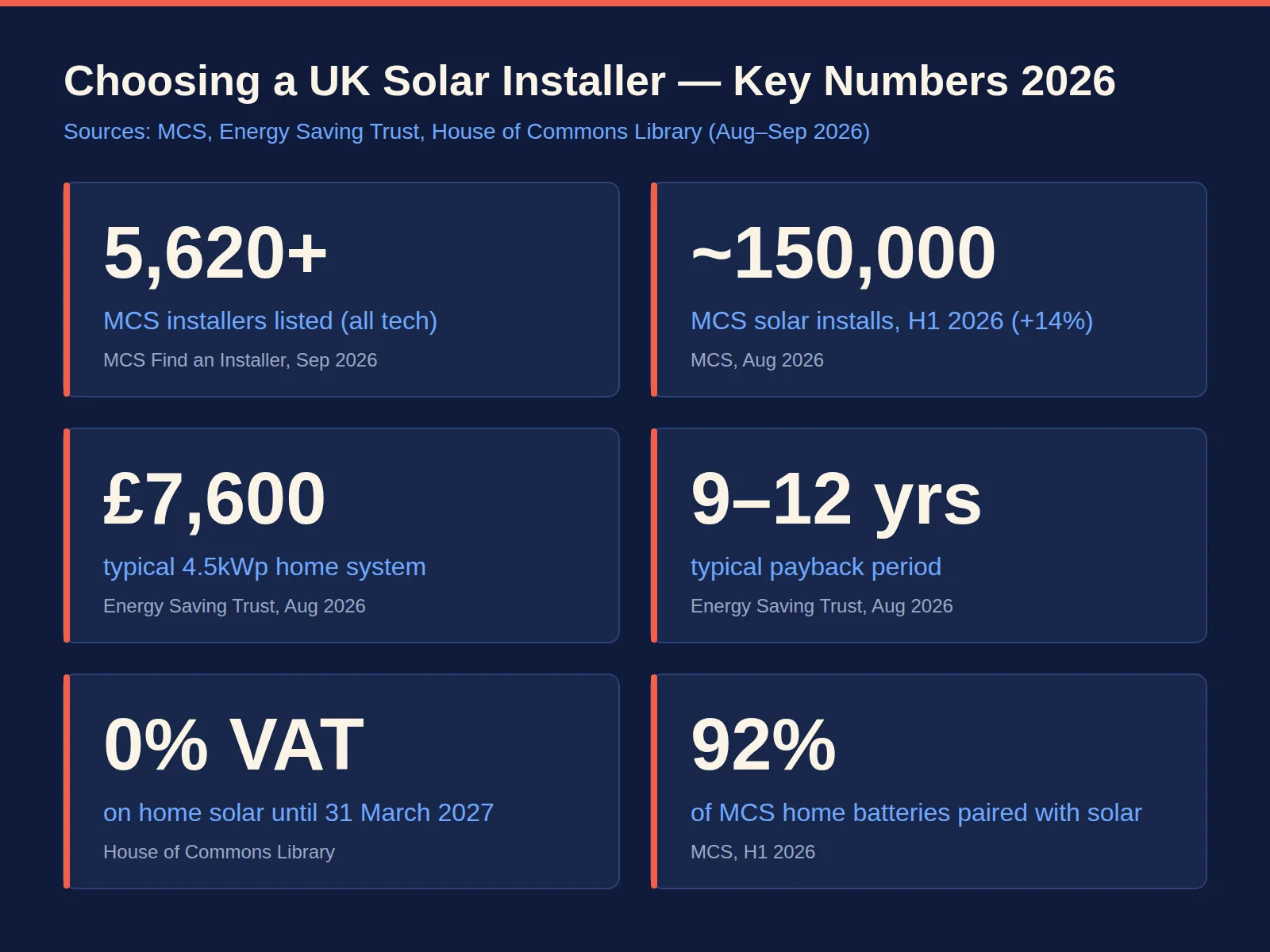
Payback varies by region. The Energy Saving Trust estimates about 9 years in London, 10–11 years in Manchester and 11–12 years in Stirling, depending on how much you’re home during the day. As a rough community benchmark, UK homeowners comparing quotes on r/SolarUK use “£1,000 per panel for a solar plus battery installation”. That is a sense-check, not a price guide.
Timing matters too. Installs on eligible homes are zero-rated for VAT until 31 March 2027, and the rate reverts to 5% on 1 April 2027 (House of Commons Library, 21 September 2026). With demand up 14% year on year, book surveys early if you want to install before the deadline.
How do you compare solar installer quotes like-for-like?
Put every quote into the same grid and compare cost per kWp, not the headline price. A cheaper quote with fewer or lower-wattage panels isn’t the better deal. Our system size guide helps you check whether each installer has sized the system to your usage.
| Line on the quote | What to check | Learn more |
|---|---|---|
| System size (kWp) and panel model | Named brand, wattage and panel count; cost per kWp | Best panels for UK homes |
| Inverter | Brand, type and warranty. The Energy Saving Trust expects replacement after about 12 years | Solar inverters explained |
| Grid connection | Who files the G98/G99 notification with your network operator | G98 vs G99 |
| Generation estimate | MCS-method kWh/year figure, with any shading and roof orientation accounted for | East-west roofs |
| Warranties | Panel product and performance, inverter, workmanship, plus the insurer behind them | Solar panel warranties |
| Extras | Scaffolding, bird mesh, isolators, monitoring and optional power-cut backup | Installation process |
What questions should you ask a solar installer near you?
Ask questions that make the installer commit in writing. Vague answers to any of these are a reason to move on to the next firm on your shortlist.
Before the survey
What is your MCS certificate number, and which consumer code are you in? How long have you traded under this company name? Will your own staff fit the system, or subcontractors?
On the quote
What is the deposit, who insures it, and when is the balance due? Who handles the network operator notification and the MCS certificate? Does my home need planning permission? The Energy Saving Trust notes most homes don’t, except listed buildings, conservation areas and national parks.
After installation
What maintenance do you recommend, and what does an aftercare visit cost? Can the system later take a solar EV charger or a heat pump? MCS says 1 in 3 installations now combine more than one technology.
“More and more households are gaining confidence in the benefits of home-grown energy, and the fact that many are now investing in multiple technologies is testament to this.”— Lisa Cooke, Managing Director, MCS
Want a like-for-like quote to compare?
Answer three questions (postcode, roof type, electricity use) and get a fixed-price specification you can hold up against any local installer’s quote. There’s no obligation to buy.
Get a solar quoteSolar panel installer near me: frequently asked questions
How do I find a solar panel installer near me?
Use the free MCS Find an Installer tool, filter by Solar PV and your postcode or region, then confirm each firm's RECC or HIES membership and check its trading history on Companies House before asking for quotes.
Does my solar installer need to be MCS certified?
In practice, yes. The MCS certificate is what energy suppliers use to confirm your system is eligible for Smart Export Guarantee payments, and the Energy Saving Trust advises using an MCS-certified installer.
How many solar installer quotes should I get?
Get at least three written, itemised quotes for the same system size and specification, then compare cost per kWp, named panel and inverter brands, warranties and what is included, such as scaffolding and grid notification.
How much deposit should a solar installer ask for?
Keep the deposit small and make sure it is insured. Installers in the RECC or HIES consumer codes must protect deposits, and RECC-approved insurers cover deposits for between 35 and 120-plus days depending on the provider. Pay the balance only after commissioning.
Is a local solar installer cheaper than a national company?
Often, but not always. UK homeowners on r/SolarUK report national firms quoting £1,000 to £2,000 more for the same specification, but you should compare like-for-like quotes rather than assume.
How much does a solar panel installation cost in the UK in 2026?
The Energy Saving Trust puts a typical 4.5kWp home system at around £7,600, with payback of roughly 9 to 12 years depending on location. A battery typically adds £5,000 to £8,000.
Do I pay VAT on solar panels in 2026?
No, if the home is eligible. Installing solar panels on eligible homes is zero-rated for VAT until 31 March 2027, and the rate reverts to 5% from 1 April 2027, according to the House of Commons Library.
What are the red flags when choosing a solar installer?
Walk away from sign-today discounts, cold calls or doorstep selling, large upfront payments, rental or subscription deals instead of ownership, quotes with no named equipment brands, and directors linked to many dissolved solar companies.